
You are adding water more than once a week
Topping off is normal in August. Topping off every few days, in every season, is not - and auto-fill valves hide it completely, which is why the first sign for many owners is the water bill.
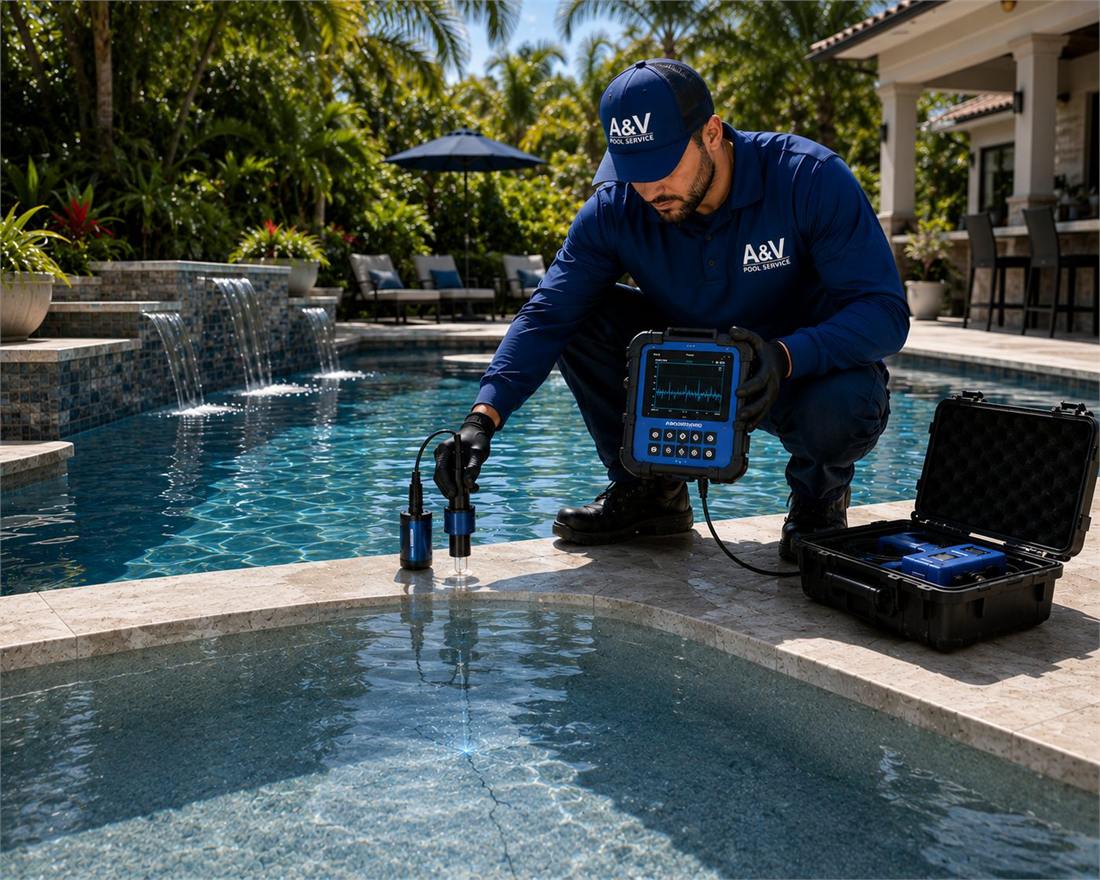
A quarter inch a day adds up fast — on your bill, in your chemistry, and eventually in the soil under your deck. We use electronic listening and pressure testing to pinpoint where the water is escaping, whether it's the shell, a return line, a skimmer throat, or a light conduit.
Pinpointing first means we open only what has to be opened. You get photos, a clear explanation, and a repair quote before any work starts.
Any one of these on its own can have another explanation. Two or more together almost always means a real leak.
Topping off is normal in August. Topping off every few days, in every season, is not - and auto-fill valves hide it completely, which is why the first sign for many owners is the water bill.
A pinhole in a pressure-side return line can move hundreds of gallons a day without ever showing at the surface.
Constant fresh water dilutes stabilizer and chlorine and drives hardness around. If your chemistry resets itself every week, you may be treating a leak rather than a chemical problem.
Water escaping a buried line washes out the fill beneath the deck. Cracked or settling pavers near the equipment pad are a classic tell.
Air coming back into the pool means the suction side is drawing air in somewhere - a leak that runs backwards, and one that will burn out a pump seal if ignored.
If loss halts at the skimmer throat or the light niche, that is where to look. A pool that keeps dropping past the returns is usually a shell or main drain issue.
Pinpointing first means we open only what genuinely has to be opened. You get photographs, a plain explanation and a repair price before any concrete is touched.
We start with a bucket test and a measured water-loss rate over a set period, with the pump both running and off. Loss that only happens with the pump running points to pressure-side plumbing; loss that happens either way points at the shell or a fitting.
We isolate and pressurise the suction and return lines one at a time. A line that will not hold pressure is a line with a hole in it, and the drop rate tells us roughly how big.
Pressurised water escaping underground makes a distinctive sound. Electronic listening gear tracks it through deck and soil to a spot rather than a general area, which is the difference between one small opening and a demolished patio.
Skimmer throats, return eyeballs, light conduits, main drains and the tile line get checked directly, with dye testing on any suspected crack to confirm flow before we call it.
You get written findings with photos and a quote. If you approve it, our own crew does the repair - we do not hand you off to a subcontractor and disappear.
Usually a cracked fitting or a pinhole from ground movement. Repaired by exposing one small section, or by rerouting the line if the run is beyond saving.
Extremely common in older South Florida pools - the plastic skimmer pulls away from the concrete shell. Sealed from inside without draining in most cases.
Water escapes through the conduit behind the fixture. Often repairable with a niche seal rather than a full deck opening.
Confirmed with dye testing, then patched or, for structural cracking, staple-and-seal repaired. Not every visible crack actually leaks.
Harder to reach and worth confirming carefully, because the fix is more involved. We rule out everything cheaper first.
Pump seals, filter unions, valve bodies and heater connections. The good news: these are visible, above ground and usually the cheapest to fix.
It takes five minutes and it tells you whether you have a leak or just Florida evaporation. If it comes out clean, you have saved yourself a service call.
We find leaks in pools and spas across Miami-Dade and Broward, from pool leak detection in Fort Lauderdale and Miami Beach to Davie, Kendall and Aventura. Pick your city below.
It depends on the size of the pool and how much plumbing has to be isolated and tested, so we quote it before we start rather than after. What we will not do is charge you for a full survey when a five-minute look at the equipment pad finds a weeping filter union. Call 954-691-6742 and describe what you are seeing and we will tell you honestly what it is likely to involve.
Almost never. Pressure testing, electronic listening and dye testing are all done with the pool full. Draining a pool in South Florida is genuinely risky because the water table is high and an empty shell can float or crack, so we treat draining as a last resort rather than a starting point.
Only where the leak actually is, and only after we have pinpointed it. The entire reason for electronic listening and pressure testing is to avoid exploratory demolition - we would rather open one square foot in the right place than ten in the wrong one.
Most residential jobs are a single visit of a few hours. Water-loss measurement needs a period with the pump off, so occasionally we do the measurement one day and the survey the next. Larger commercial and condo pools with more plumbing runs take longer.
Roughly, yes - a quarter of an inch a day is typical South Florida evaporation, more in peak summer heat and wind, less in cooler months. Consistently losing half an inch or more a day is worth investigating, and an inch a day is a leak until proven otherwise.
That points at the pressure side - the return plumbing that pushes water back into the pool. Those lines are only under pressure while the pump runs, so the leak effectively switches on and off with it. It narrows the search considerably and is good news, because it usually means the shell is fine.
We repair it ourselves. A&V is a licensed pool contractor - CPC1456836 - so the same crew that locates the leak does the plumbing repair, the skimmer seal or the shell patch. You get one point of contact and one warranty.
Yes, and it is a significant part of our commercial work. Shared pools lose more money to leaks than private ones simply because they are bigger and heated more. We provide written findings with photographs that a board or property manager can put in front of owners to justify the repair.
Get a free quote today and let's get your water sparkling before the weekend.