
Free chlorine: about 1–3 ppm
Enough to sanitize, adjusted upward when stabilizer is higher. South Florida sun burns it off fast, so the stabilizer level matters a lot.
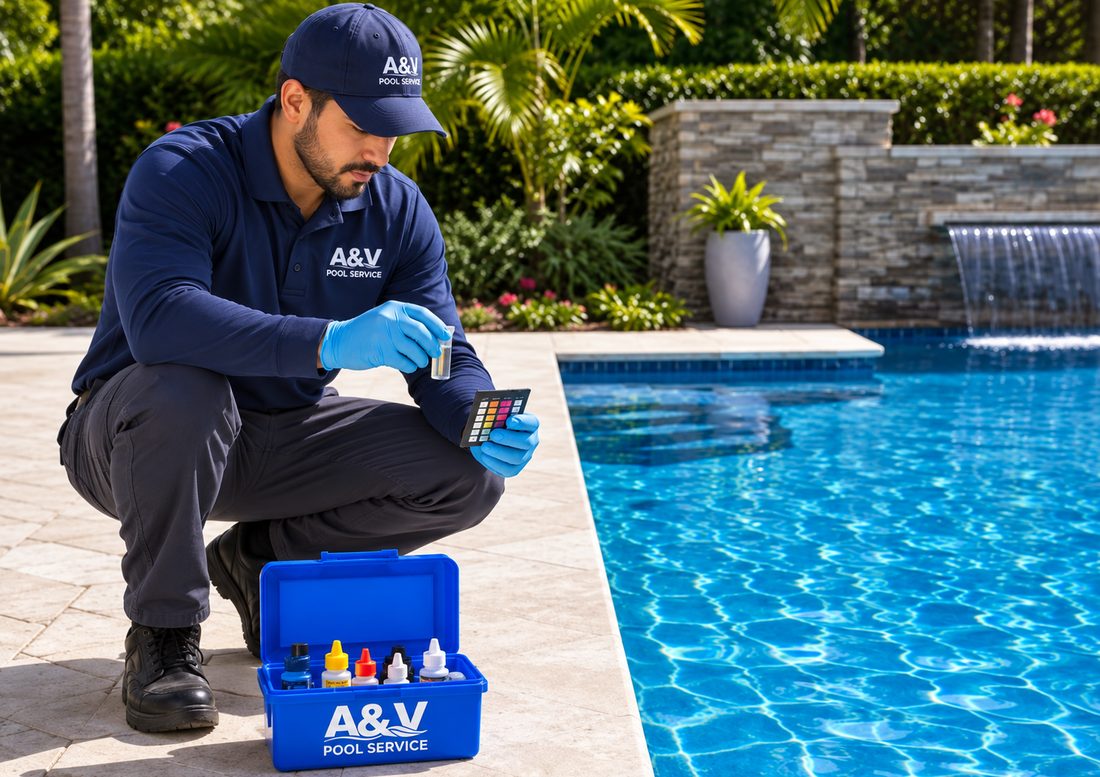
Balanced water is not just chlorine. pH, alkalinity, calcium hardness, cyanuric acid (stabilizer) and salt all pull on each other, and South Florida heat, rain and hard water move them constantly. Water that is out of range eats equipment, stains and etches surfaces, clouds up, and irritates swimmers' eyes and skin.
We test the full panel on every visit, dose precisely, and log the numbers so you can see the history. That is how we catch slow drifts — like stabilizer creeping up or calcium building toward scale — long before they become expensive.
We use reagent test kits for the readings that matter, not just strips, and we look at the whole balance, including the saturation index, which tells us whether water will scale surfaces or dissolve them.
These are general targets for residential pools. We fine-tune them to your finish, equipment and whether you have a salt system.
Enough to sanitize, adjusted upward when stabilizer is higher. South Florida sun burns it off fast, so the stabilizer level matters a lot.
Comfortable for eyes and skin and where chlorine works well. Salt pools tend to drift upward, so we watch it closely.
Keeps pH steady. Heavy rain can lower it; some fill water raises it.
Protects plaster. South Florida fill water is already calcium-rich and evaporation concentrates it, so we manage it to avoid scale.
Shields chlorine from sunlight. Too much weakens chlorine and invites algae, a very common problem in pools using tablets.
Most residential salt cells want roughly 2,700–3,500 ppm, with about 3,200 ppm ideal. We check your model's requirement.
Chlorine, pH, alkalinity, calcium, stabilizer and salt, plus phosphates when algae keeps returning.
We calculate doses for your pool's volume rather than guessing, and add chemicals in the right order.
Numbers are recorded every visit so trends are visible and problems are caught early.
Corrosive water damages heater exchangers, pump seals and ladders; scaling water clogs salt cells and heaters.
Correct balance prevents etching, staining and calcium scale on plaster, pebble and tile.
No red eyes, no itchy skin and no green tint on blonde hair.
Balanced water holds chlorine better, so you use less of it.
If you notice these, it is time for a full test.
Rain, heat and heavy use swing chemistry differently from city to city. We test and balance water everywhere below, including pool water testing in Miami, Doral, Hollywood, Parkland and Palmetto Bay.
At least weekly, and after heavy rain or heavy use. Heat, sun and storms move chemistry quickly here, which is why weekly service includes a full test every visit.
A strong 'chlorine' smell usually means combined chlorine (chloramines), not too much chlorine. It is a sign the pool needs more free chlorine or a shock to clear the waste.
Calcium from hard South Florida water, concentrated by evaporation and pushed out of solution by high pH or alkalinity. Keeping the water balanced slows it down.
Yes. A salt system makes chlorine, but pH, alkalinity, calcium and stabilizer still need to be tested and adjusted, and salt pools tend to push pH up.
Cyanuric acid, or stabilizer, protects chlorine from sunlight. Some is essential in Florida, but too much makes chlorine less effective and can lead to algae.
Yes. Call us to arrange a water test and balance visit, and we will explain the results and what we recommend.
Get a free quote today and let's get your water sparkling before the weekend.